Occupational Therapy for Young Children and the Early Childhood Approach
If your child is younger than 9 and you're worried about their development or they have a disability, the NDIS early childhood approach is usually the first step. An early childhood partner can connect you with supports quickly, including Early Supports for children under 6, and help you apply to the NDIS. Children on the NDIS can have occupational therapy as early childhood supports.
Who Is the Early Childhood Approach For?
Children younger than 6 with delays in their development, or younger than 9 with disability.
The NDIA says the approach helps families support their child to build the skills they need to take part in everyday life. Early childhood partners are local organisations the NDIA funds, with teams experienced in working with young children and their families. Where there's no partner in your area, the NDIA works with you directly.
What Are Early Connections?
Quick ways into support, delivered by an early childhood partner.
- Connections with community and mainstream supports and services
- Practical information about your child's development
- Peer support from other families
- Early Supports, if your child is younger than 6 with developmental concerns
- Help to apply to the NDIS, if your child is likely to be eligible
Early Supports are delivered by an early childhood partner, usually for 3 to 6 months and up to 12 months, and are designed to help you support your child to build skills in everyday settings.
Looking for an Occupational Therapist?
We'll connect you with an occupational therapy practice that may have space.
Where Does an OT Fit In?
For children with NDIS funded early childhood supports, an OT can be one of the professionals working with the family.
The NDIS Pricing Schedule 2026-27 includes early childhood items for occupational therapists, described as evidence-based early childhood intervention supports for children 0 to 9 and their families. The NDIA says children learn and develop in natural, everyday settings, so expect an OT working with young children to focus on home, childcare, playgroup and preschool routines, and on coaching you.
What Is Thriving Kids?
An Australian Government program for children aged 8 and under with developmental delay or autism and low to moderate support needs.
The Department of Health, Disability and Ageing says Thriving Kids started in October 2026, with all supports in place by 1 January 2028, and that NDIS access doesn't change until 1 January 2028. States and territories are rolling out targeted supports, which can include occupational therapy, on their own timelines. If your child isn't on the NDIS, ask what's available where you live.
Free Family Guide
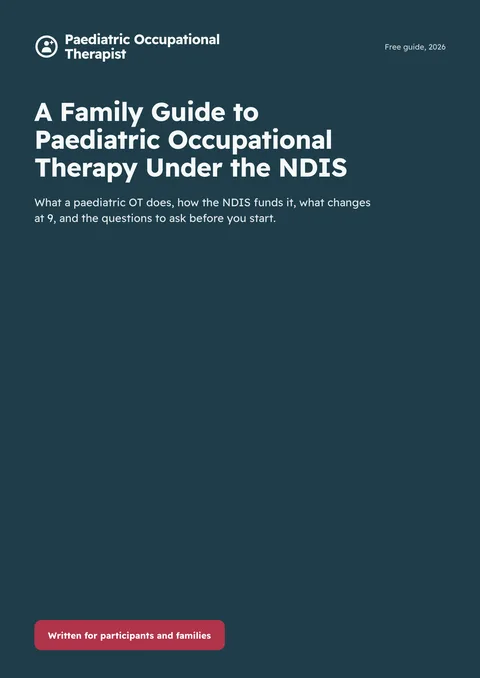
Free PDF, sent to your inbox.
Questions People Ask
Do I need a diagnosis to talk to an early childhood partner?
No. Early connections are there when you have concerns about your child's development. A child must meet the NDIS requirements to become a participant.
Can I see a private OT while we wait?
Yes. You don't need a referral to see an OT privately. Ask about fees first.
What if there's no early childhood partner near us?
The NDIA says it works directly with families where there isn't a partner in the area.
Who do Aboriginal and Torres Strait Islander families call?
The NDIA lists First Nations Connect on 1800 411 640.
Keep Reading
- NDIS OT for childrenHow the NDIS funds occupational therapy for children: therapy supports, early childhood supports for under 9s, what changes at 9, and who can provide it.
- When your child turns 9What changes for a child's occupational therapy at 9: moving from an early childhood partner to a local area coordinator, and how therapy funding changes.
- Self-care skillsHow a paediatric occupational therapist helps children learn self-care: getting dressed, eating, toileting, washing and sleep routines, with NDIS funding.
- What is paediatric OT?Paediatric occupational therapy helps children with disability or delay with play, self-care, fine motor skills, sensory needs and school.
We share your details with one provider at a time, never a list. Privacy policy